
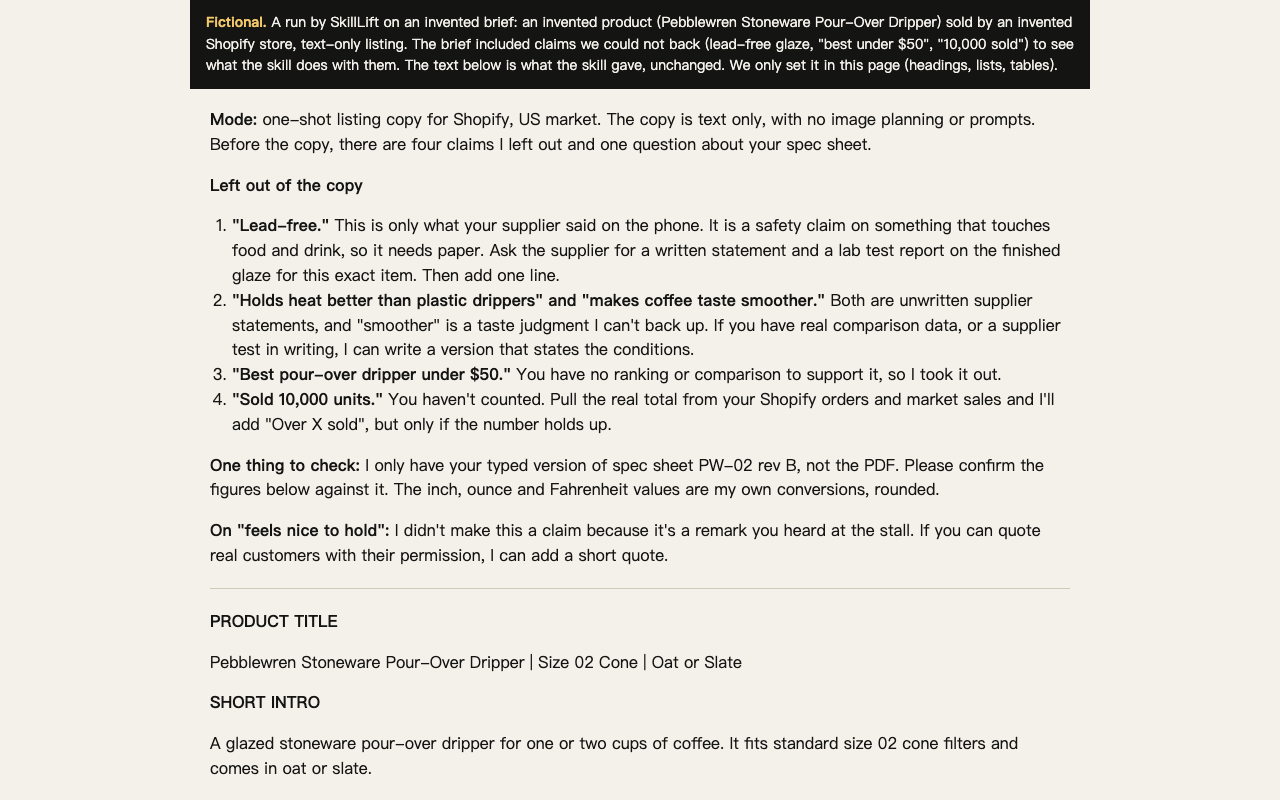
This picture is from one run by SkillLift on an invented brief. It is not from the project.
E-commerce Visual Copywriting
Turns your product facts into listing copy, and says which claims it left out because nothing proves them.
E-commerce Visual Copywriting · feichanggege · MIT
Install
One line
npx skills add feichanggege/ecommerce-visual-copywriting-skill
Commands are copied word for word from the project's README. Read them before you run them.
We ran it once
The brief: Invented: a Shopify store selling a made-up product, the Pebblewren Stoneware Pour-Over Dripper, to US customers. We asked for listing text only (title, intro, bullets, description, spec table, two FAQs), no images, no questions. The brief gave written spec-sheet facts, three things the supplier said only on the phone (lead-free glaze, holds heat better, tastes smoother), and two claims we wanted it to refuse: "best under $50" and "10,000 sold" (the seller had not counted). Fictional; the label is on the page and on the poster. The page carries the skill's text unchanged and only sets it in headings and lists.
It picked a one-shot mode and put four claims in a "left out" list before the copy: lead-free (supplier said it by phone only, ask for a lab report), better heat and smoother taste (unwritten, and taste is a judgement), best under $50 (no ranking), and 10,000 sold (not counted, pull the real total). It then wrote plain English listing text from the spec sheet and the seller's own notes, with the price and the "filters not included" fact in the right places, and a short self-review table.
What we thought: On the point that matters for listing copy, it did well: given a seller who wanted to claim "best" and "10,000 sold" and had only phone-call proof for the safety claim, it refused all of them, said why, and told the seller what proof to get. The plain text is good enough to paste, once you check the unit conversions and cut its few soft touches. But it is an image-planning tool first. Use it for the evidence ledger and the refusals, not for pretty text, and expect to say "text only" out loud.
Open the full outputOne run by an AI agent on 2026-11-02, at commit 7fd4aba. No person has judged it, and your result will differ.
Why it was picked
It writes product copy from an evidence ledger: each claim is marked as proven, said by the supplier, or guessed, and only the proven ones reach the page.
Why it exists
Listing copy tends to drift into claims nobody can prove. This sorts what you say into proven, supplier-said and guessed before it writes anything.
What you get
A written plan or plain listing text, plus a list of what was left out and why. By default it also writes image prompts; ask for text only if you do not want them.
How it works
- Install the skill.
- Give it the product facts, the spec sheet and who buys it, and say if you want text only.
- Read the list of left-out claims, and get the proof for the ones you want back.
What it needs
An agent that can read files. Optional word-count scripts need Python.
In short
Pick this when you need honest listing copy and a clear list of what you still have to prove.
Worth knowing
We show none of its sample images. One appears to be a figure of a character from a real video game (our reading of the picture), one is a lamp ad under a shop name we could not check, and the durian one carries a real variety and origin that its own worked example says it cannot prove. We saw no rule or example in its text that depends on a real brand. It is built around image plans and image-generation prompts, and its main files are written in Chinese with an English companion. We asked it for listing text only: it gave plain English text (title, intro, bullets, description, spec table, two questions and answers) and left out every claim we had marked as unprovable. It still added a few soft touches of its own, such as calling a colour "a soft neutral" and picturing "a quiet morning at home", and it converted units itself. Its China ad-law and platform rules go out of date; it says so and tells you to check official sources. It runs no code on its own, and its optional checking scripts only count words and scan text. We did not look at the fallback project named in our notes, since this one passed.
Used in these workflows
- Promote a product step 2