
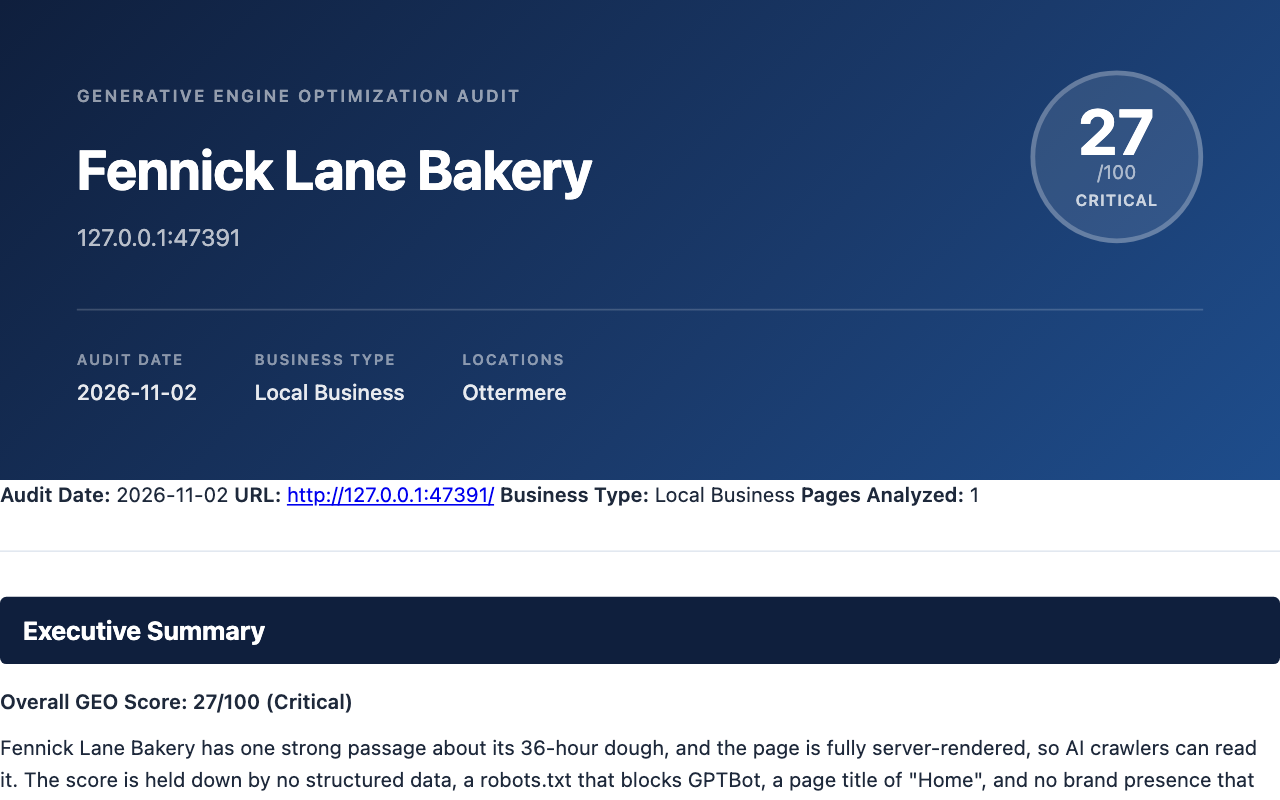
This picture is from one run by SkillLift on an invented brief. It is not from the project.
GEO-SEO Claude
Gives any web page a score for how ready it is for AI search, then lists what to fix and writes the fixes.
GEO-SEO Claude · Zubair Trabzada · MIT
Install
Clone it and run its installer
git clone https://github.com/zubair-trabzada/geo-seo-claude.git
cd geo-seo-claude
./install.sh
Commands are copied word for word from the project's README. Read them before you run them.
We ran it once
The brief: Audit a one-page website for Fennick Lane Bakery, an invented sourdough bakery in the invented town of Ottermere. We wrote the page and its robots.txt ourselves and served them from a local file, with nothing fetched from third parties. (The bakery, town, phone number and figures are all made up. output.html carries no label so the report stays as the skill's template renders it.)
It gave the page a composite score of 27 out of 100, listed 14 issues by severity, and wrote a filled-in LocalBusiness JSON-LD block, an llms.txt, two passage rewrites and a 30-day plan. It found the real faults we had left in the page: GPTBot blocked, a title of "Home", no schema, no sitemap. It also picked out the one passage with real facts as the strongest.
What we thought: It does what the listing suggests, and the fixes for crawler access, tags, schema and passages are concrete enough for a small-business owner or marketer to use, with no API key or third-party account. The score itself is softer than it looks: it is estimated, partly unmeasured here, and never checked against a real AI engine. The report looks tidy and client-ready, though not beautiful. Use it for the to-do list, not as proof of visibility.
Open the full outputOne run by an AI agent on 2026-11-02, at commit 989cae0. No person has judged it, and your result will differ.
Why it was picked
It turns a web address into a scored audit with fixes you can paste in, and no feature needs an API key or a third-party account. We picked it for the to-do list, not for the score.
Why it exists
People now ask AI tools for recommendations, and many sites block AI crawlers or say nothing an AI could quote, without anyone noticing.
What you get
A Markdown report, or a PDF if you add pandoc: a score out of 100, issues by severity, passage rewrites, structured data, an llms.txt and a 30-day plan.
Skills in this pack
geo-auditThe full audit: a score out of 100, issues by severity, and a 30-day plan.geo-citabilityScores each passage for how easily an AI could quote it, with rewrites.geo-crawlersChecks whether robots.txt lets AI crawlers in.geo-llmstxtChecks or writes an llms.txt file.geo-schemaFinds structured data and writes what is missing.geo-technicalTags, sitemap, rendering and security headers. Page speed is only a risk estimate.geo-contentReviews experience, expertise, authority and trust signals.geo-platform-optimizerEstimates readiness for each AI search platform. It does not query them.geo-brand-mentionsLooks for your brand on public pages such as Wikipedia, Reddit and YouTube. No account needed.geo-report-pdfTurns the audit into a PDF. Needs pandoc and Google Chrome.
How it works
- Clone it and run the installer.
- Open Claude Code and type /geo audit with your web address.
- Start with the quick wins, and do not treat the score as proof that AI tools can see you.
What it needs
Claude Code and Python 3.10 or later. The PDF also needs pandoc and Google Chrome, both free. No feature needs an API key or a third-party account.
In short
Pick this when you want a concrete list of fixes for a website, not a measurement of AI traffic.
Worth knowing
It does not ask ChatGPT, Perplexity or any other AI engine whether your site appears: platform scores are estimates from your page, and most scores are the agent's judgement against a rubric, so two runs can differ. Brand checks read public pages with no login, so results from LinkedIn, G2 or Crunchbase may be incomplete, and a small local business scores low there whatever its quality. We did not check the project's market statistics. Its one-line curl install is not shown here because it runs whatever that address serves at the time. The installer shown writes into ~/.claude and downloads Python packages. The download also holds agency tools that write priced proposals, a sample audit naming a real company, and a README that promotes a paid community. You need none of these.